

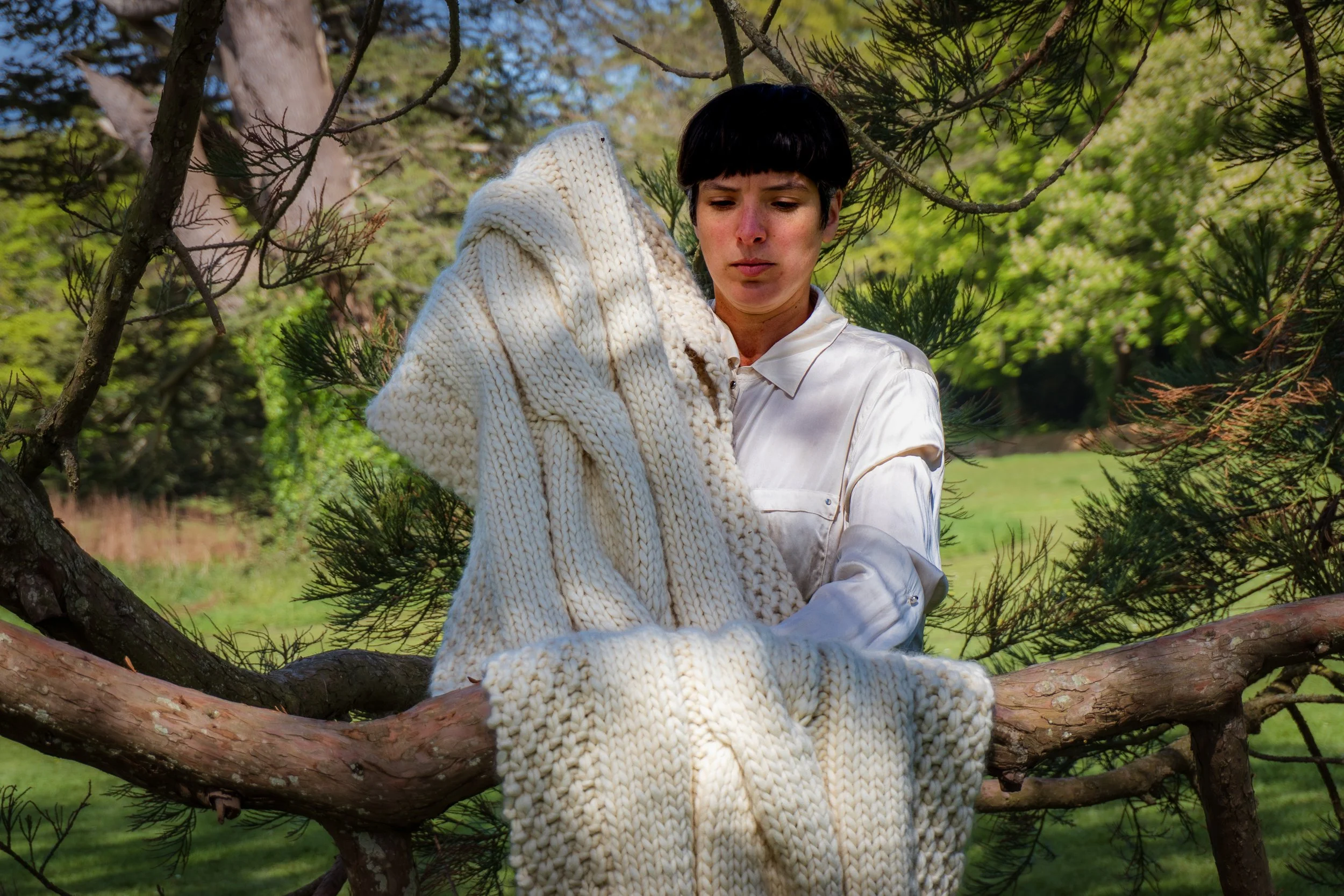
Nandi Statement
I use knitting to explore what happens when I allow a piece to develop through making rather than beginning with a fixed design.
I work without written patterns, relying on my hands, memory and intuition to build and alter each piece as I go. I may begin with a structure I know, a particular fibre or a colour combination that catches my attention, but I do not always know where the piece will end. Decisions are made along the way, often spontaneously, in response to what I am seeing and feeling.
At the moment, I am particularly interested in mohair and silk and in what happens when different fibres, textures and colours meet. I am drawn to colour combinations that are unexpected to me rather than necessarily harmonious. I like the moment when two colours create a reaction I did not anticipate, or when a change in fibre alters the way a familiar structure behaves. These experiments often become the starting point for a piece rather than an illustration of an idea I had beforehand.
Touch is central to how I work. I pay close attention to softness, weight, movement, surface and the way a textile sits against the body. For me, a piece is not fully understood by looking at it. Its texture, temperature, lightness or weight can change the way it is experienced, and I want these physical qualities to be active in the work. I am interested in making pieces that create a desire to touch, wear, hold or interact with them.
My work moves between wearable pieces and textile objects, but I am less interested in defining them by what they are than by what they can do through material, colour and touch. A bonnet, a scarf or a knitted object can become a place to test an idea, follow a material, or make an unexpected decision.
My visual language is personal and constantly developing. It comes from what I have learned, but also from what I choose to keep, change, exaggerate or leave behind. I am not trying to reproduce the traditions I have encountered. I am interested in what happens when that knowledge becomes part of my own way of working and is transformed through my preferences, memories and instincts.
I want the work to retain evidence of the hand that made it. The irregularities, changes and decisions that happen during knitting are not things I try to eliminate; they are part of how the piece becomes itself. For me, making is not simply the execution of a finished idea. It is where the idea develops.